
The Growth and Development of Secret Societies
This article comes from a 1910 Knights of Pythias manual written by Capt. Hugh Goold Webb P.C, P.G.R..
"If Fraternal Love held all men bound, how beautiful this world would be.”
Bede, the Saxon historian, tells us that when St. Paulinus came to the old Danish kingdom of Northumbria to preach the Gospel of the Christians, King Eadwine was so inclined to hear him, and wishing his people to do so too, called his council together, and asked them whether permission should be given. One of his chief Thanes said "Let us certainly hear what this man knows, for it seems to me that the life of man is like the flight of a sparrow through a large room, where you, King, are sitting at supper in winter, while storms of rain and snow rage abroad. The sparrow, I say, flying in at one door and straightway out again at another, is, while within, safe from the storm; but soon it vanishes out of sight into the darkness whence it came. So the life of man appears for a short space ; but of what went before, or what is to follow, we are always ignorant." This wise saying of the old Thane can be appropriately applied to the history of secret societies; we know not their beginnings, though we can form some idea as to how they have originated by the study of ancient man and the works he has left behind, and which are found scattered throughout the whole world.
As far back as history takes us there can be found associations of men, whose internal workings were kept from the knowledge of all the outside world. Even further back still, at the very "Dawn of History", we find suggestions of similar bands; and, in the present times, they are found among all nations of the world, savage or civilized, and among all religions, heathen or Christian.
The first trace of man having lived upon the earth are seen in the weapons that were used for hunting and for defense. These are found in ancient river beds and gravel deposits in connection with the remains of the extinct mammoth, woolly rhinoceros, cave lion and bear, the Irish elk, and other animals long since passed away. By these remains, which consist chiefly of spear and arrow heads, axes, knives, etc., roughly made of flint and bone, we learn that man lived a very simple mode of life; he had no fixed place of abode, and no idea of nationality, though there appears to have been some tie that held him and his fellow-men together for the sake of mutual protection. He spent his time hunting and fishing. In preserving the skins of the animals he slew, and in the making of weapons. The fact that weapons of flint only are found in one place, while those of bone only in another, seems to show that at this early period some kind of association was in existence for the purpose of certain manufactures.
There is no doubt that the secret societies, or mysteries, of the ancient historic people, were the schools for the study of the arts and sciences, industrial and otherwise, and that these schools gave to the empire its principal men. its kings, its architects, its law makers, and its priests, all received their training in them; yet primarily, however, these societies originated in religious observances.
Among the ancient mysteries, there was not one but what originally taught the knowledge of a living God. Dr. Mackey says that it was the "Patriarchal mode of worship established by God himself. With this pure system of truth, secret societies are supposed to have been coeval and identified. But the truth thus revealed by divinity came at length to be doubted or rejected through the imperfection of human reason; and though the visible symbols were retained in the mysteries of the pagan world, their true interpretations were lost." And consequently, the secular portion of the mystery became more important, and "The life that now is" was the one thing cared for, and the mysteries took on the form of fraternity ; but, as these mysteries laid special stress upon the preparation for the "Life that was to come," we have in these very early ages, in the very dawn of history, a recognition of the "Fatherhood of God and the Brotherhood of Man."
It is said that the first and original mystery was that of Isis and Osiris of Egypt. From there, Zoroaster took them to Persia ; Cadmus to Greece ; Orpheus to Thrace; Malanpsus to Athens; and so they spread to Rome, and through Rome to the rest of the world. The most noted of these mysteries were the Orphic, Bacchic, Eleusian, Samothracian, Cabiric, Mithric and Isian.
These mysteries taught a future life with eternal punishment of the wicked ; that the initiated were happier than other mortals; that after death they flew directly to the habitations of the Gods. Plato says "That the design of initiation was to restore the soul to that stage from which it fell; while Epictetus asserts, "Thus the mysteries became useful; thus we seize the true spirit of them, when we begin to apprehend that every thing therein was instituted by the ancients for instruction and amendment of life."
All persons, who were initiated into these mysteries, were required to produce evidence of their fitness; they were to be of a good moral and religious character, and to have lived pure lives; and thus, we are told "The wisest and best of the pagan world invariably held that the mysteries were instituted pure, and proposed the noblest end by the worthiest means." To them were sent the youths of the nations, Whose chief time, outside the study of the mysteries of religion, was devoted to architecture ; especially was this true in Egypt and Chaldea, the ruins of whose magnificent temples and palaces are the wonder of the architects of today. It was from the members of these same societies, too, that there came the kings, statesmen and warriors of Egypt. To them, were drawn from their homes in ancient Greece, such men as Pythagoras, Herodotus and others, seeking "More light" by being initiated into and taking the vows of the mysteries ; and not only thus learning, but having the courage afterwards of teaching and proclaiming, "The truth."
The mysteries into which Pythagoras had undoubtedly been admitted were (1) the Eleusian into which he had been admitted before leaving Greece ; those of Isis and Osiris while in Egypt, and that of Cabiri, during his travels after leaving Egypt.
As before mentioned, these mysteries were carried from Greece into Rome ; and here we find them both in its temples and schools ; the society of the Vestal Virgins being perhaps the most noted.
But the most important fact in connection with secret societies, is that in Rome we have the first account of what is most likely the origin of our modern Trades Unions. In this connection we read : "The establishment of corporations at Rome, with which certain artisans and handicraftsmen were initiated, was extremely advantageous to them when they were removed into foreign provinces." We find much information concerning these colleges in ancient inscriptions, and it is very probable that together with the trades of Rome this form of social unions, as well as the hereditary obligations under which the former were conducted, was propagated in Britain, and was the original germ of those gilds, which became so influential in Europe some centuries after the cessation of the Roman dominion."
Although the Romans may have, and most probably did, propagate their ideas of trade unions among the Saxons, yet we know from Saxon history itself, that "Gilds" had been in existence among them long before the Romans ever saw the land of Britain.
These early English Gilds were organized for local self help; yet they did not neglect the form and practice of religion, justice and morality. We find, too, even then there were two different forms of these Brotherhoods.
In the earlier gilds, the "wed" or obligation, was given by the member personally for himself as an individual, and these organizations taught that the love for one's neighbor was not to be coldly accepted, but was to be known and felt, and acted upon as a life habit. Thus a "gild" of this class was an association of men and women, for the purpose of individual benefit, and led up to the benefit societies of today.
The later form of these early Saxon Gilds, was an institution known as "Frith-Vork" or peace pledge. This pledge was given by one member for others; it was a banding together of men within the limits of a boundary in which all members were bound together by the pledge, for the keeping of peace, and the performance of public duties. This was the origin of the modern town, city, and county corporation.
We are told that "English Gilds, as systems of widespread practical institutions, are older than any Kings of England. They are spoken of in the old books that contain the oldest relics of English Law." The old laws of King Alfred, of King Ina, of King Athelstan, of King Henry I, reproduced still older laws in which the universal existence of gilds is treated as a matter of well-known fact, and in which it is taken as a matter of course that everyone belonged to some gild.
The gilds were entirely secular; a priest was allowed to join, and often did, but only in his private character ; he had no more authority than any other member; yet we find that the most pleasing trait of these earlier gilds are the evidences of a simple piety, and a faith that entered into the everyday life of their members.
We know the names of some of the English Guilds that existed in these far off times. The " Cnihten-Gild " (or "Young Men's Guild") of London was as old as the time of King Edgar, who gave it its charter. We have notice of even an older Gild in a grant of land made in the time of Ethelbert. There is still in existence the agreement and by-laws made by the brothers of a certain Thegns' Guild at Cambridge and others at Abbottsbury, Exeter and Woodbury. Women as well as men were admitted into the orders; the members were of all grades of life, from the highest to the lowest, and all enjoyed social equality at the meetings. King Henry VIII. and Cardinal Wolsey were brothers of the Guild of St. Barbara of London, and the Guild of the Trinity at Coventry boasted of Henry IV. and Henry VI. as members.
The oldest statute relating to these Gilds, is the "Three Gilds Statute," in which we find— The Gild of Abbotsbury was founded by Grey, a friend of King Canute the Great, in honor of God and St. Peter. It was instituted for the support and nursing of infirm Gild-brothers, the burial of the dead, the performances of religious service, and prayers for the souls of the members. The Gild met once a year on the eve of the feast of St. Peter. After the praise and religious service, there was a common meal. The poor of Abbotsbury received alms of bread, "well boulted and thoroughly baked," contributed by the brothers or the cure of the day. Guests were invited by the consent of the Master and Steward. Insults offered by one brother to another were punished by the Gild and had to be atoned for. He who undertook an office and did not perform its duties was severely disciplined.
The Exeter Gild was of similar constitution, but the religious objects were more prominent. The Gild-members met three times a year for prayers for the living and dead. "When a brother died, every member was obliged to perform special devotions for his soul and make a contribution of money for the funeral ; those on a journey were supported and cared for as well as those who suffered loss by fire.
The statutes of the Gild at Cambridge shows that its object was different from that of the other two. In the oath taken on admission, the brothers swore they would be faithful towards each other in both religious and secular matters; and though there was the same support in sickness and death, as there were other regulations as to alms, worship, feasts, etc., as in Abbotsbury and Exeter; yet these were subordinate to the protection of members against criminals, and even against the evil consequences of their own acts. "If one misdo, let all bear it; let all share the same lot," was the first principle of the Gild, and a complete organization was effected to carry this principle out. If a brother needed help, the inferior officer nearest to him hastened to his aid ; should he neglect, he was severely punished; so likewise was the head of the brotherhood, should he neglect to offer aid. If one was robbed all aided in obtaining compensation from the robber. If a brother committed wilful murder he was left to himself; but if he was provoked, or obliged to execute vengeance, all helped to make atonement for the deed. The Gild was formed for the material and financial aid to its members; and all bound themselves by an oath to support him who had right on his side.
The meetings of these Gilds were held at least once every year, at the annual feast. The members were from all grades of life, from the King to the common laborer; but all enjoyed social equality in the Gild hall. Women were admitted on equality with the men. Each member, on admittance took an oath of obedience and was given the kiss of peace. Assessments were made for the poor and distressed, and for the funeral expenses of deceased members. The ceremonies were always commenced with a parade through the streets, the members, both brothers and sisters, wearing the robes or uniforms of the Gild to which they belonged.
Several of these ancient Gilds have survived until the present time ; and the parade of the Lord Mayor of London is now the only remnant of these old pageants. It takes place when the Mayor-elect is escorted by the various Guilds of London to the Guild Hall to take the oath of office.
We have now traced from historic sources the continuance of secret societies from the very earliest times, to the present day ; and as man has advanced in civilization, so have these societies advanced in nobleness of purpose as well as in membership, and are found all over the world, organized, some for social purposes, some for beneficial purposes and some for purely political purposes.
In this connection it is interesting to note that secret societies have existed among the aboriginal inhabitants of our own land from time immemorial to the present ; and the rites, ceremonies and rituals of several of them are known and preserved. A few white men and women having been admitted into them, and received from their Medicine Men full explanations of all the ceremonies have written comprehensive accounts of several of these societies, from which we learn that they have their lodge rooms, their several degrees, their pass words, sign, and badges. The lodge rooms are arranged differently for each degree ; though sometimes each degree has its own separate room, and the candidate passes from one to another; the ceremonies generally lasting a week or more. The chief officers are appointed for life, while the lesser ones are appointed as required. The following is a description of the "Midewiwin" or Grand Medicine Lodge of the Ojibways. The lodge room is of course in an open grove or clearing and built of poles set into the ground and interlaced with boughs and foliage, its length, set due east and west, is eighty feet, and it is twenty feet wide. Midway in the eastern and western walls are doorways with walls of four feet built outside at right angles, like a pair of open gates. Cedar trees are planted a short distance from the corners on the outside. Opposite the principal entrance, the eastern doorway is a round sweat-house.
The arrangement of the interior for the first degree is shown in the diagram 1 is the large fiat sacred stone ; 2 a rug or mat to receive the presents ;
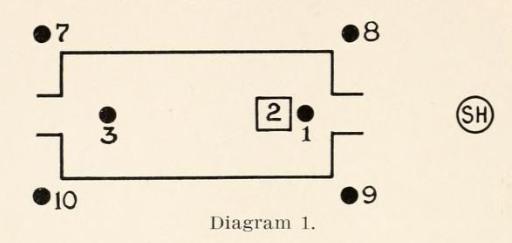
3 a cedar post 7 feet high by 6 or 8 inches in diameter, painted red with a green top, and upon which is placed a stuffed owl. 7, 8, 9 and 10 are the cedar trees. In the second degree (diagram 2)
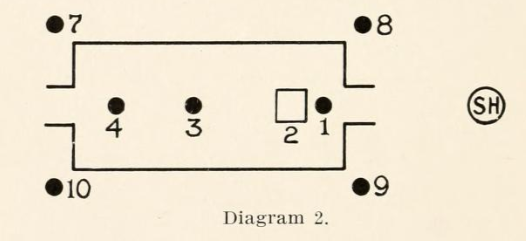
the arrangement of the lodge is the same as the first, but with the addition of post No. 4, which is a round cedar post painted red with white spots on all sides; the owl being placed on its top.
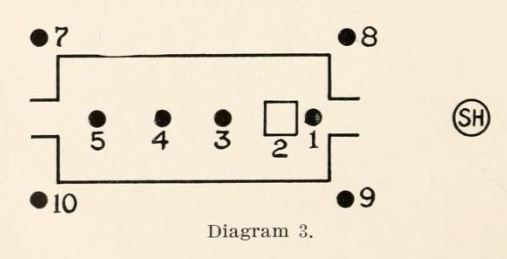
The third degree (diagram 3) has an additional post, No. 5. This is square, and painted black. The fourth and last degree is arranged somewhat differently from the others (diagram 4). Besides the doors on the east and west, it has also one on both the north and south sides; the degree post No. 6 is in the form of a Latin cross, the three arms and upper half of the trunk are round and colored white with red spots; the lower half of the trunk is square, colored white on the east side, green on the south, red on the west, and black on the north.
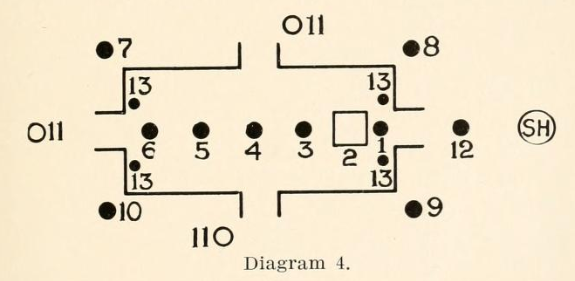
The owl keeps its place on the second degree post. Off the north, south and west doors are low round structures called bear nests (11). Ten paces in front of the east entrance is a board 3 feet high, and 6 inches wide. (12) the top cut in the three lobes, having a hole near the center lobe ; it is painted green towards the sweathouse, and red towards the Midewigiwan, on each side of the east and west doors are placed posts 5 feet high (13), painted red inwards and black on the reverse, and having a stone placed at the foot of each.
The arrangement of the lodges show a progressive and extensive ritual, and the lessons taught are chiefly the blessings of rain, and the supplication for continued plenty in the food stuffs of the earth, together with the medicinal properties of herbs and the formulas for their applications.
The secret societies of today may be divided into two classes, those whose every action, and even membership, is kept from public knowledge, and those whose only secrets are the methods by means of which one member may know another, and the process of initiation.
The first division consists of orders like that of the anarchists, Mafia, Clan-Na-Gael, who not only keep their membership secret but the place and time of their meetings, and the object for which they are bound together. The only thing known about them is their names, and the pernicious, unlawful and criminal results of their deliberations. It is the acts of such societies that have brought odium and suspicion upon all secret orders, and have caused the opposition of some of the Christian churches toward them. This objection, however, is not confined to the churches, but extends to individual members of society ; and in nearly all cases we may state these objectors know nothing of their own personal knowledge of secret societies, and never having entered a lodge room, they cannot legally or logically form any opinion of their merits or demerits. They judge the first named societies by the results of their meetings; why not judge the fraternal societies in the same way? Were they to do so their verdict would be different.
The secrets of the second class of secret societies are few. They proclaim themselves to the world in the parades seen upon our public streets, in the jewels and buttons worn upon their persons, and in the pride with which they own their membership. We find among them the most law abiding citizens of the country, from the President to the laborer; any good, sober, honest man can join them; their places of meeting are known and published, and their objects are seen by the love and care they give to their sick members, by the comfort they carry into the homes of the distressed, by the care and education of their orphans, and by the burying of their dead. As the "tree is known by its fruit," so should the secret society be judged by its actions; if bad, condemned ; if good, commended and encouraged. The objects, as enumerated above, are the lessons taught and enforced by obligations and vows taken at the altar of the lodge room ; and there is no doubt that each member (and therefore all mankind) is brighter and better for his membership.
A Dream of the Pre-Historic by Duncan Campbell Scott
Naked and shaggy, they herded at eve by the sound of the seas, When the sky and the ocean were red as with blood from the battles of God, And the wind like a monster sped forth with its feet on the rocks and the trees, And the sands of the desert blew over the wastes of the drought-smitten sod.
Here, mad with the torments of hunger, despairing they sank to their rest. Some crouching alone in their anguish, some gathered in groups on the beach ; And with tears almost human the mother looked down on the babe on her breast, And her pain was the germ of our love, and her cry was the root of our speech.
Then a cloud from the sunset arose, like a cormorant gorged with its prey, And extended its wings on the sky till it smothered the stars in its gloom. And even the famine-worn faces were wet with the wind-carried spray. And dimly the voice of the deep to their ears was a portend of doom.
And the dawn that rose up on the morrow, apparelled in gold like a priest, Through the smoke of the incenses of morning looked down on a vision of death ; For the vultures were gathered together and circled with joy to their feast, On hearts that had ceased from their sorrow, and lips that had yielded their breath.
Then the ages went by like a dream, and the wise one emerged from the deep, And the stars as they watched through the years saw a change on the face of the earth ; For over the blanket of sand that had covered the dead in their sleep Great forests grew up with their green, and the sources of rivers had birth. And here in the aftertimes, man, the clear faced and smooth handed, came by. And he built him a city to dwell in and temples of prayer to his God;
He filled it with music and beauty, his spirit aspired to the sky, While the dead by whose pain it was fashioned lay under the ground that he trod.He wrenched from great Nature her secrets, the stars in their courses he named, He weighed them and measured their orbits ; he harnessed the horses of steam ; He captured the lightnings of heaven, the waves of the ocean he tamed, — And even the wonder amazed him as one that awakes from a dream.
But under the streets and the markets, the banks, and the temples of prayer. Where humanity labored and plotted, or loved with an instinct divine. Deep down in the silence and gloom of the earth that had shrouded them there were the fossil remains of a skull and the bones of what once was a spine.
Enfolded in darkness for ever, untouched by the changes above, And mingled as clay with the clay which the hands of the ages had brought. Were the hearts in whose furnace of anguish was smelted the gold of our love. And the brains from whose twilight of instinct has risen the dawn of our thoughts.